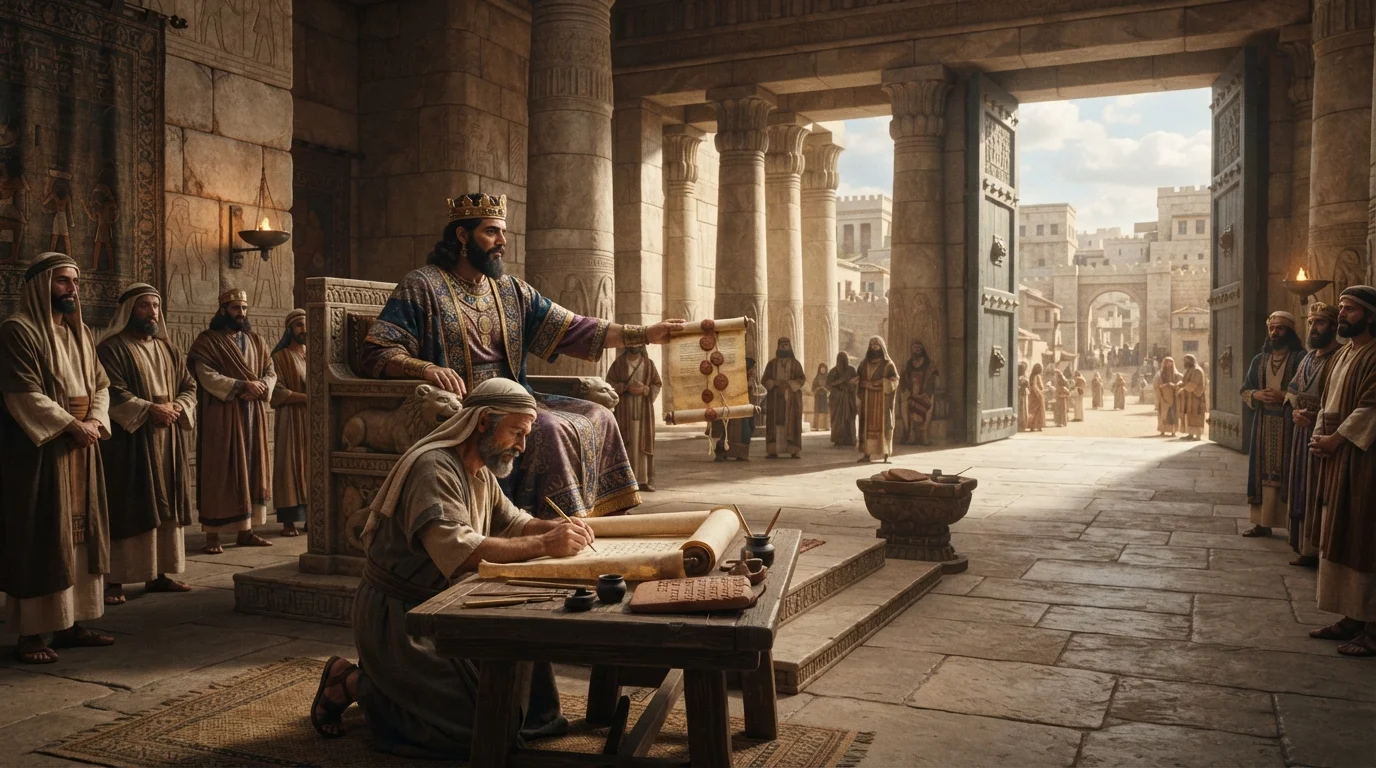
Have you ever wondered what a decree means in the Bible and what it tells us about authority and God’s will? A decree is a formal order, command, or decision made by someone who has authority.
In Scripture, the word can describe commands issued by kings and rulers, as well as established decisions or purposes associated with God. Biblical decrees may relate to laws, judgments, promises, or events that have been firmly established.
For example, the Book of Daniel uses the idea of a royal decree when describing commands made by kings. Understanding the decree meaning in the Bible helps readers recognize how authority, obedience, judgment, and divine purpose are presented in Scripture.
What Does “Decree” Mean in the Bible?
At its core, a decree in the Bible is an official, authoritative command or declaration something spoken or written by a ruler, judge, or by God Himself that carries the full weight of law. Once a decree is issued, it isn’t a suggestion. It’s binding. It is final.
Think of it like this: if a king in the ancient world made a decree, nobody in his kingdom could simply ignore it or argue their way out of it. The decree carried the authority of the throne.
The Hebrew Roots Behind “Decree”
In the Old Testament, several Hebrew words get translated as “decree” in English Bibles, including:
- Choq (חֹק) – meaning a statute, ordinance, or something “engraved” or fixed, like a law carved into stone.
- Dath (דָּת) – often used in the book of Esther to describe the legal edicts of the Persian kings.
- Gezerah (גְּזֵרָה) – meaning something “cut” or “decided,” referring to a firm ruling or decision.
The Greek Word Behind “Decree” in the New Testament
In the New Testament, the Greek word most often translated as “decree” is dogma (δόγμα). You can actually hear the English word “dogma” hiding inside it. This term referred to an official ruling, ordinance, or public decision made by a governing authority such as Caesar Augustus’s decree for a census in Luke 2:1, or the decisions made by church leaders in Acts 16:4.
Decrees Issued by Human Rulers in the Bible
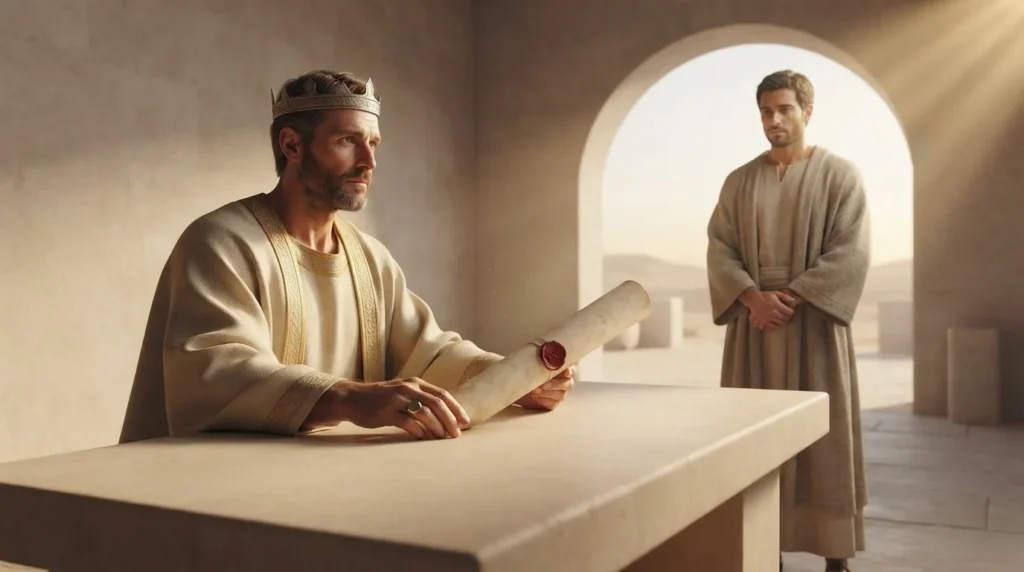
Before we dive into the theological weight of God’s decrees, it’s worth looking at how the Bible uses this word in a very human, historical sense because it shows up more often than you might expect.
1. The Decree of Caesar Augustus (Luke 2:1)
This wasn’t a polite request. It was an empire-wide command requiring every citizen to register for a census and it’s the very reason Joseph and Mary traveled to Bethlehem, setting the stage for the birth of Jesus. A single political decree, made by a powerful Roman ruler with no idea he was playing a part in a much bigger divine plan, ended up fulfilling ancient prophecy about the Messiah’s birthplace.
2. King Cyrus’s Decree to Rebuild Jerusalem
In Ezra 1:1, King Cyrus of Persia issues a decree allowing the Jewish exiles to return home and rebuild the temple in Jerusalem. This decree fulfilled prophecy spoken by Jeremiah decades earlier, showing how even a pagan king’s official command became a tool in God’s larger redemptive plan.
These examples remind us that decrees in the Bible weren’t abstract religious ideas they were real political and legal tools used by real governments, and Scripture shows God working through them, around them, and sometimes directly against them.
Decree Meaning in the Bible: God’s Sovereign Decrees
Now here’s where things get really powerful. While human decrees show up throughout Scripture, the most significant use of the word “decree” in the Bible refers to God’s own decrees His sovereign, unshakable declarations over creation, history, and the future.
What Is a Decree of God?
A decree of God is a divine declaration that is:
- Authoritative – it comes from the ultimate source of power in the universe
- Unchangeable – once God decrees something, it will happen
- Purposeful – it always serves His larger plan
- Sovereign – it isn’t subject to override by any human power
Psalm 2:7 “I Will Tell of the Decree”
One of the clearest and most quoted examples is found in Psalm 2:7:
“I will tell of the decree: The Lord said to me, ‘You are my Son; today I have begotten you.'”
This verse is often understood as a prophetic declaration about the Messiah God’s decree establishing His Son’s identity and authority. It’s not a wish or a hope. It’s a fixed, divine announcement of what is true and what will be.
Job 28:26 and God’s Decree Over Creation
Job 28:26 describes God setting “a decree for the rain and a way for the lightning of the thunder.” This shows decrees weren’t only about human affairs the Bible presents God’s decrees as the very laws that govern the natural world. The seasons, the weather patterns, the boundaries of the sea all of it operates according to divine decree.
This gives us a beautiful picture: nature itself obeys God’s decrees perfectly, without hesitation or rebellion, something humans often struggle to do.
Why the Concept of Decree Matters for Understanding God’s Sovereignty
So why does any of this matter for us today?
Here’s what that means in practical terms:
- God’s plans are not “plan B” reactions to human choices they are decreed in advance.
- Nothing catches God off guard, because His decrees establish the framework of history.
- Even when human rulers issue their own decrees (like Caesar or Cyrus), God can work through, around, or in spite of them to accomplish His purposes.
- Believers can find comfort knowing that God’s decrees are trustworthy what He has declared will come to pass, regardless of circumstances.
This is part of why theologians sometimes talk about “the decrees of God” as a category in systematic theology referring to God’s eternal plan and purpose that governs creation, salvation, and the unfolding of human history.
Decree vs. Command: What’s the Difference?
It’s easy to confuse a decree with a command, but there’s a subtle and important distinction:
| Term | Meaning | Example |
| Command | An instruction given, often with the expectation of obedience, but which can be disobeyed | “You shall not steal” (Exodus 20:15) |
| Decree | An authoritative declaration establishing what will happen or what is legally binding | “I will tell of the decree” (Psalm 2:7) |
In other words, a command tells someone what they should do, while a decree establishes what will be whether that’s a law, a plan, or a fixed reality.
Decree Meaning in the Bible: Key Examples Across Scripture
Let’s take a closer look at some additional passages where the word “decree” plays an important role, so you can see just how varied and how consistent its usage really is.
1. Daniel 4:24 The Decree of the Most High
In Daniel’s interpretation of King Nebuchadnezzar’s dream, he says:
“This is the interpretation, O king: it is a decree of the Most High, which has come upon my lord the king.”
Here, a specific judgment against Nebuchadnezzar is described as a divine decree showing that God’s decrees aren’t only about creation or salvation, but can also involve discipline and judgment in human affairs.
2. Zephaniah 2:2 “Before the Decree Takes Effect”
“Before the decree takes effectbefore the day passes away like chaffbefore there comes upon you the burning anger of the Lord…”
This is a prophetic warning, urging people to repent before a decreed judgment arrives. It reflects the urgency biblical writers attached to divine decrees once issued, time was limited to respond.
3. Esther 8:8 Decrees That Cannot Be Revoked
“For an edict written in the name of the king and sealed with the king’s ring cannot be revoked.”
This detail highlights the seriousness ancient cultures placed on royal decrees, and it’s a helpful backdrop for understanding just how much more serious and permanent a divine decree would be understood to be.
4. Acts 17:26 Decreed Times and Boundaries
“And he made from one man every nation of humanity to live on all the face of the earth, having determined allotted periods and the boundaries of their dwelling place.”
Paul, speaking in Athens, points to God’s decree over the rise and fall of nations and the specific times and places people would live a powerful reminder that history itself unfolds according to divine purpose, not random chance.
Practical Lessons We Can Learn From Biblical Decrees

So what can we actually take away from all this, beyond historical and theological interest? Quite a lot, actually.
1. God’s Word is trustworthy.
If God’s decrees over creation and prophecy have proven reliable rain still falls, seasons still change, prophecies about Jesus were still fulfilled then we can trust His promises to us personally as well.
2. Human authority is temporary; God’s authority is eternal.
Kings like Xerxes, Cyrus, and Caesar all had real power in their day, but their decrees eventually faded into history. God’s decrees, by contrast, are described as everlasting.
3. Decrees invite response.
Just as Zephaniah warned people to respond before judgment fell, Scripture invites us to respond to God’s decreed truths His decree about His Son, His decree about salvation, His decree about the future with faith and obedience.
How Different Bible Versions Translate the Word “Decree”
If you’ve compared different Bible translations, you may have noticed that translators don’t always use the word “decree.” Depending on the version, the same original Hebrew or Greek term might be translated as:
- Statute
- Ordinance
- Edict
- Ruling
- Law
- Decision
- Judgment
This is completely normal in Bible translation work, since translators are trying to capture the closest modern English equivalent to an ancient legal or royal term.
Final Thoughts
So, what’s the bottom line? The decree meaning in the Bible points to something firm, authoritative, and final whether it’s a Roman emperor ordering a census, a Persian king rescuing a nation, or God Himself establishing the boundaries of the sea and the identity of His Son.
Understanding this word helps us read Scripture with fresh eyes.
FAQs About Decree Meaning in the Bible
1. What is the simplest definition of “decree” in the Bible?
A decree in the Bible is an official, authoritative declaration either from a human ruler or from God that carries the force of law and is expected to be fulfilled or obeyed without exception.
2. What is the difference between a decree and a covenant in the Bible?
A covenant is a binding agreement or promise, often involving mutual commitments between two parties (such as God and His people). A decree, on the other hand, is a one-sided authoritative declaration that doesn’t require agreement from the other party it simply states what will happen.
3. What does Psalm 2:7 mean by “I will tell of the decree”?
In this verse, the psalmist is quoting God’s own declaration establishing the special relationship and authority of His Son. Many scholars connect this passage to Messianic prophecy, ultimately fulfilled in Jesus Christ.
4. Are God’s decrees the same as His commands?
Not exactly. Commands (like the Ten Commandments) can be disobeyed by people. Decrees regarding God’s own sovereign plans and purposes, however, are described in Scripture as unstoppable and certain to occur.
5. Why does the Bible mention decrees from pagan kings like Cyrus and Caesar?
These examples show how God can work through political and historical events even ones issued by non-believing rulers to accomplish His larger purposes, such as fulfilling prophecy or setting the stage for major biblical events.
6. Is the word “decree” used the same way in the Old and New Testaments?
The core meaning stays consistent an authoritative, binding declaration but the Old Testament often uses it for both divine and royal legal rulings, while the New Testament frequently uses it (via the Greek word “dogma”) for imperial edicts and early church decisions.

Jack Harrison is a passionate writer and researcher at TruthVarse.com, dedicated to creating clear, helpful, and engaging content for curious readers. He enjoys exploring topics related to biblical meanings, spirituality, symbolism, and everyday questions, turning complex ideas into simple and easy-to-understand information.
Through careful research and a reader-first approach, Jack aims to provide content that is informative, practical, and enjoyable to read. His goal is simple: to help readers discover meaningful insights while making every article easy to understand and useful.