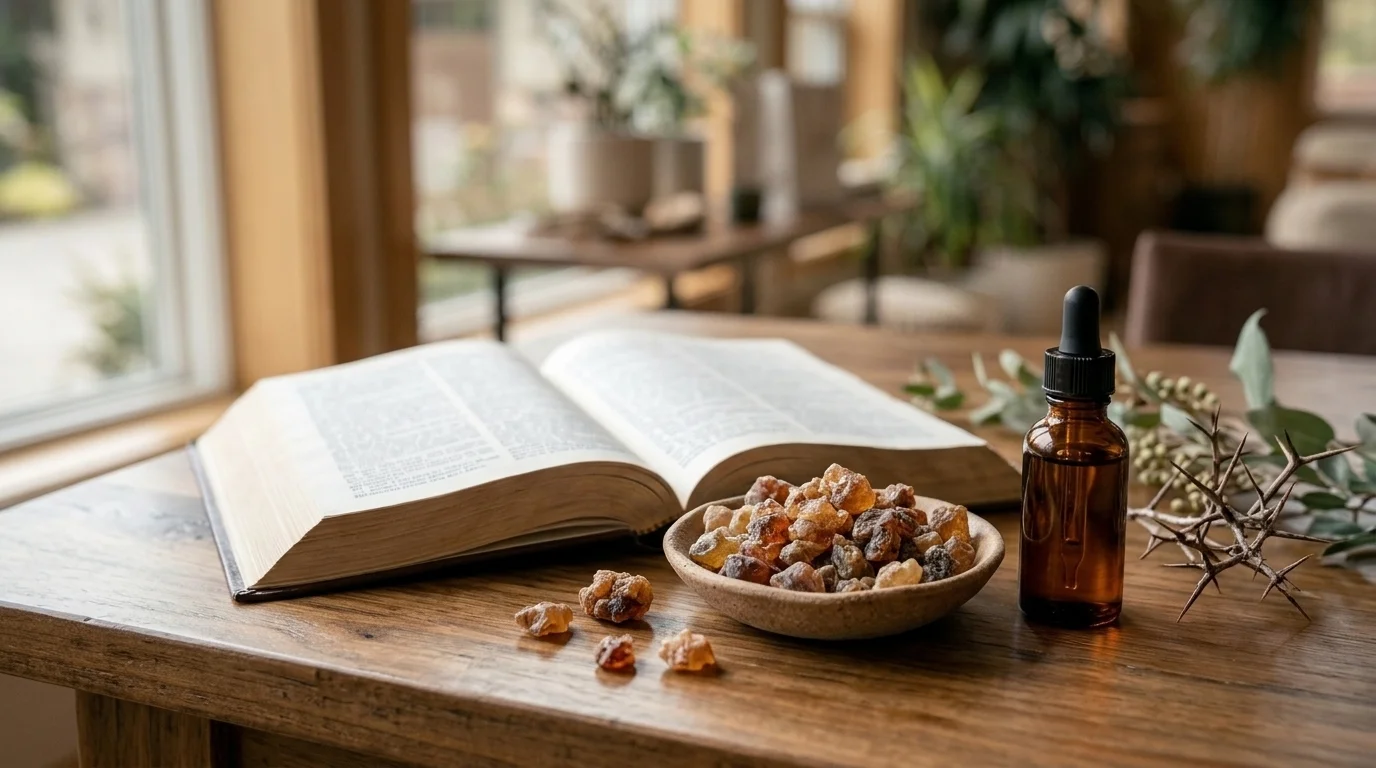
Have you ever wondered what myrrh means in the Bible and why this valuable substance appears in several important biblical stories? Myrrh is a fragrant resin obtained from certain thorny trees and was used in ancient times for perfume, incense, anointing oil, and burial preparations.
In the Bible, myrrh carries historical and spiritual significance, often appearing in connection with worship, honor, and sacrifice. One of its most familiar mentions is in Matthew 2:11, where the wise men present myrrh, gold, and frankincense to the child Jesus.
Myrrh also appears in John 19:39, where Nicodemus brings a mixture of myrrh and aloes for Jesus’ burial. These passages connect myrrh with both the honor given to Jesus and the events surrounding His death.
What Is Myrrh? A Quick Overview
Before diving into the spiritual symbolism, it helps to know what myrrh actually is.
Myrrh is a natural gum resin that oozes out of small, thorny trees belonging to the Commiphora species, which grow primarily in the Arabian Peninsula, Somalia, and parts of Ethiopia. When the bark of these trees is cut or naturally cracks, a sticky sap seeps out. This sap hardens into reddish-brown droplets or “tears” once exposed to air.
Ancient traders would harvest these hardened resin tears and either sell them whole or grind them into powder. Myrrh had an unmistakable bitter, earthy aroma in fact, its name likely comes from the Hebrew word mor, meaning “bitter.” That bitterness wasn’t a flaw; it was part of what made myrrh so valuable and symbolically loaded throughout Scripture.
Why Was Myrrh So Valuable in Biblical Times?
In the ancient world, myrrh was worth more than its weight in gold in many contexts. Here’s why:
- Rarity – It only grew in specific, hard-to-reach regions, meaning it had to travel long distances via caravan trade routes.
- Multi-purpose use – It functioned as perfume, medicine, embalming agent, and incense all at once.
- Labor-intensive harvesting – Collecting resin drop by drop from thorny trees was slow, difficult work.
- Religious significance – It was a required ingredient in the holy anointing oil used in the Tabernacle and Temple.
Because of all this, myrrh became a fitting symbol for anything precious, sacrificial, or set apart for something holy.
Myrrh Meaning in Bible: The Core Symbolic Themes
When you trace every mention of myrrh in Bible passages, a pattern starts to emerge. Myrrh consistently represents four major ideas:
- Worship and consecration
- Love and intimacy
- Suffering and death
- Healing and preservation
Let’s walk through each of these, along with the actual verses where myrrh appears, so you can see how these meanings unfold across different books of Scripture.
1. Myrrh as a Symbol of Worship and Consecration
One of the earliest and most important appearances of myrrh in the Bible is found in Exodus, where God gives Moses very specific instructions for making the sacred anointing oil used to consecrate the Tabernacle, the priests, and holy objects.
In Exodus 30:23-25, God instructs Moses to take “flowing myrrh” along with cinnamon, cane, cassia, and olive oil to create this special oil. This wasn’t an ordinary household fragrance it was reserved exclusively for sacred purposes. Anyone who tried to replicate it for personal use faced serious consequences (Exodus 30:32-33).
This tells us something important: myrrh wasn’t just a nice-smelling ingredient. It was a marker of holiness, something that set apart people and objects for God’s exclusive use. When priests were anointed with oil containing myrrh, it signified that they were dedicated entirely to sacred service.
2. Myrrh as a Symbol of Love and Romance
Shift over to the Song of Solomon, and myrrh takes on an entirely different flavor literally and figuratively. In this poetic book celebrating romantic love between a bride and groom, myrrh appears repeatedly as a symbol of desire, beauty, and intimacy.
Consider these verses:
- “My beloved is to me a bundle of myrrh that lies between my breasts” (Song of Solomon 1:13)
- “I went down to my garden… to gather myrrh with my spice” (Song of Solomon 5:1)
- “His lips are lilies, dripping liquid myrrh” (Song of Solomon 5:13)
Here, myrrh isn’t associated with death or mourning at all. Instead, it represents attraction, sensuality, and the sweetness of romantic love. The bride wears myrrh as perfume, and it becomes a metaphor for the pleasure and depth of the couple’s relationship.
This dual nature myrrh as both bitter and beautiful reflects something profound about the human experience itself. Life often holds both sweetness and sorrow at the same time, and myrrh captures that tension perfectly.
3. Myrrh as a Symbol of Suffering and Death
This is perhaps the most well-known association people have when they think about the myrrh meaning in Bible narratives its connection to Jesus’s death.
Myrrh appears twice in the Gospels in connection with Jesus’s crucifixion and burial:
- In Mark 15:23, Jesus was offered wine mixed with myrrh before his crucifixion, likely as a mild sedative to dull pain. He refused it.
- In John 19:39, Nicodemus brought a mixture of myrrh and aloes weighing about seventy-five pounds to prepare Jesus’s body for burial, following Jewish burial customs.
This connection to death wasn’t random. Myrrh had long been used in burial preparations throughout the ancient Near East because of its preservative and antiseptic qualities. Wrapping a body in cloth soaked with myrrh helped mask the odor of decay and slow decomposition.
So when myrrh shows up at Jesus’s crucifixion and burial, it’s pointing to something deeply symbolic: even in his death, there was reverence, care, and an acknowledgment of the weight of what had happened. The bitterness of myrrh mirrored the bitterness of the moment yet it also pointed forward to preservation, and ultimately, resurrection.
4. Myrrh as a Symbol of Healing and Preservation
Beyond its ceremonial and funerary uses, myrrh was genuinely valued in the ancient world for its medicinal properties. People used it to:
- Treat wounds and skin infections due to its antiseptic qualities
- Soothe digestive issues
- Relieve pain (similar to how it was offered to Jesus before crucifixion)
- Preserve bodies during embalming, especially in Egyptian and Jewish traditions
This practical, healing dimension adds another layer to the symbolism. Myrrh wasn’t just about death it was also about care, comfort, and preservation of life for as long as possible.
Myrrh and the Wise Men: The Most Famous Biblical Reference

No discussion of myrrh meaning in Bible stories would be complete without addressing its most famous appearance the gift given to baby Jesus by the Magi.
In Matthew 2:11, the wise men (traditionally believed to be three, though the Bible never specifies a number) presented the infant Jesus with three gifts: gold, frankincense, and myrrh.
Each gift carried deep symbolic weight:
- Gold represented royalty fitting for a king.
- Frankincense represented divinity and worship it was burned as incense in temple worship.
- Myrrh represented mortality and suffering foreshadowing that this child would eventually die a sacrificial death.
This is a stunning piece of biblical foreshadowing. At the very beginning of Jesus’s life, a gift associated with burial and death was placed in his manger. Many Bible scholars and theologians see this as an early sign pointing toward the crucifixion that would take place roughly thirty-three years later.
This single gift transforms the nativity story from a simple birth narrative into something layered with prophetic meaning. The wise men, likely unaware of the full theological implications, were unknowingly presenting a gift that summarized Jesus’s entire earthly mission: to live, to suffer, to die, and ultimately, to rise again.
Other Notable Mentions of Myrrh in Scripture
While the examples above are the most significant, myrrh appears in a handful of other biblical passages worth knowing about:
- Genesis 37:25 – Ishmaelite traders carrying myrrh (among other spices) to Egypt is mentioned when Joseph’s brothers sell him into slavery, showing myrrh’s role in ancient trade routes.
- Genesis 43:11 – Jacob instructs his sons to bring myrrh as part of a gift to the Egyptian official (who was actually Joseph) to secure favor.
- Esther 2:12 – Women preparing to meet King Ahasuerus underwent months of beauty treatments, including six months with oil of myrrh, highlighting its use in beauty and purification rituals.
- Psalm 45:8 – A royal wedding psalm describing garments “fragrant with myrrh, aloes, and cassia,” again tying myrrh to celebration and royalty.
- Proverbs 7:17 – Used in a cautionary tale about seduction, where a woman perfumes her bed with myrrh, aloes, and cinnamon.
Why Understanding Myrrh’s Biblical Meaning Still Matters Today

You might be thinking: this is all interesting history, but why should it matter to someone reading the Bible in the modern world?
Here’s why this symbolism still resonates:
- It deepens your understanding of Christmas. Knowing what myrrh represented transforms the nativity story from a sweet children’s tale into a profound theological statement about sacrifice from the very start of Jesus’s life.
- It highlights the coexistence of joy and sorrow. Just as myrrh shows up in both love poetry and burial customs, life often holds both celebration and grief simultaneously. This mirrors the human experience in a way that feels honest and relatable.
- It reveals God’s attention to detail. The fact that a specific spice threads through Exodus, Song of Solomon, the Gospels, and Revelation-adjacent themes of worship shows a remarkable narrative consistency across a book written by dozens of authors over centuries.
- It reminds us that even bitter things can be sacred. Myrrh’s bitterness wasn’t seen as a negative it was viewed as valuable, set apart, and meaningful. This can be a powerful metaphor for how we process difficult seasons in our own lives.
Quick Reference: Myrrh Meaning in Bible Verses
For a fast overview, here’s a simple breakdown of where myrrh appears and what it signifies in each instance:
| Bible Reference | Context | Symbolic Meaning |
| Genesis 37:25, 43:11 | Trade goods, gift to Egyptian official | Value, trade, favor |
| Exodus 30:23-25 | Holy anointing oil | Consecration, holiness |
| Esther 2:12 | Beauty treatments | Purification, preparation |
| Psalm 45:8 | Royal wedding garments | Celebration, royalty |
| Proverbs 7:17 | Seduction scene | Sensuality, temptation |
| Song of Solomon (multiple) | Romantic poetry | Love, desire, intimacy |
| Matthew 2:11 | Gift from the Magi | Mortality, sacrifice, foreshadowing |
| Mark 15:23 | Offered to Jesus at crucifixion | Suffering, pain relief |
| John 19:39 | Burial preparation | Death, honor, preservation |
Frequently Asked Questions About Myrrh in the Bible
1. What does myrrh symbolize in the Bible?
Myrrh generally symbolizes sacrifice, suffering, and consecration, though it also appears as a symbol of love and beauty in poetic texts like Song of Solomon. Its meaning shifts depending on context, but bitterness and preciousness are consistent themes.
2. Why did the wise men give myrrh to baby Jesus?
Myrrh was traditionally associated with burial and mortality in the ancient world. Many scholars believe this gift foreshadowed Jesus’s eventual death and burial, making it a symbolically loaded gift even at his birth.
3. Is myrrh mentioned anywhere besides the nativity story?
Yes, myrrh appears throughout the Old and New Testaments, including in Exodus (holy anointing oil), Song of Solomon (romantic imagery), Esther (beauty treatments), and the Gospels (Jesus’s crucifixion and burial).
4. What is the difference between frankincense and myrrh in biblical symbolism?
Frankincense was typically burned as incense and associated with worship and divinity, while myrrh was used in burial and healing contexts and associated with mortality and sacrifice. Together with gold, they formed a complete symbolic picture of Jesus as king, God, and sacrificial savior.
5. Was myrrh used for medicinal purposes in biblical times?
Yes, myrrh had genuine antiseptic and pain-relieving properties. It was used to treat wounds, ease digestive issues, and was even offered to Jesus as a mild sedative before his crucifixion, though he declined it.
6. Why is myrrh associated with love in Song of Solomon?
In Song of Solomon, myrrh represents desirability and intimacy between the bride and groom. Its use as a personal perfume worn close to the body made it a natural symbol for closeness and romantic affection.
7. Does myrrh have any significance in modern Christian worship?
While myrrh isn’t commonly used in modern church settings, it remains a popular symbol during Advent and Christmas services, often referenced in sermons and hymns to remind believers of the connection between Jesus’s birth and his eventual sacrificial death.
Final Thoughts
So, what’s the real takeaway here? The myrrh meaning in Bible texts isn’t a single, simple definition it’s a layered symbol that shows up at some of the most emotionally significant moments in Scripture. From the sacred anointing oil in Exodus, to the passionate love poetry of Song of Solomon, to the sobering gift brought by the Magi, and finally to the burial preparations after the crucifixion, myrrh consistently represents something set apart, valuable, and deeply meaningful.

Jack Harrison is a passionate writer and researcher at TruthVarse.com, dedicated to creating clear, helpful, and engaging content for curious readers. He enjoys exploring topics related to biblical meanings, spirituality, symbolism, and everyday questions, turning complex ideas into simple and easy-to-understand information.
Through careful research and a reader-first approach, Jack aims to provide content that is informative, practical, and enjoyable to read. His goal is simple: to help readers discover meaningful insights while making every article easy to understand and useful.