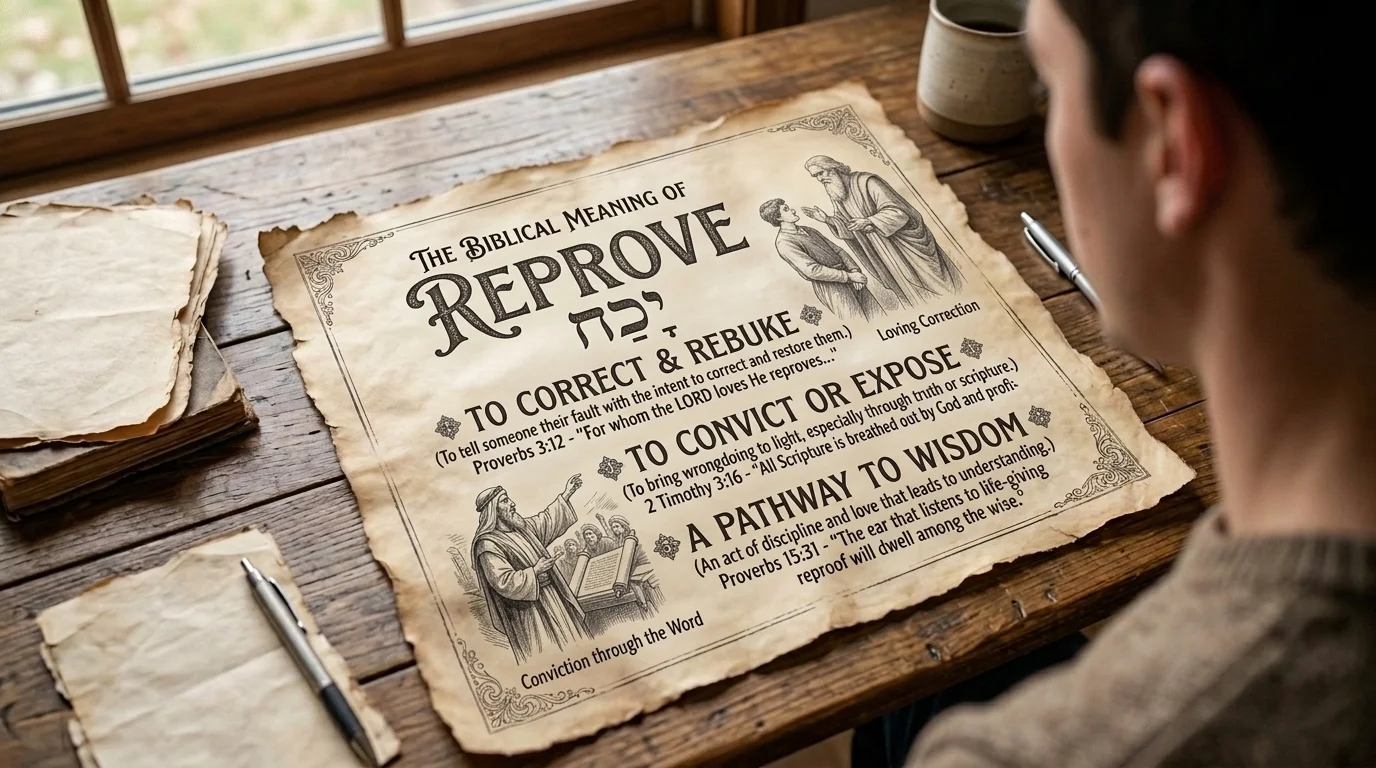
Have you ever wondered what reprove means in the Bible and why this word is connected with correction and guidance? Reprove means to point out a mistake, correct wrongdoing, or show someone why their actions or beliefs are wrong.
In the Bible, reproof is often used to help people recognize their mistakes, turn away from sin, and follow God’s teachings. Scripture encourages believers to accept correction with humility and wisdom rather than responding with pride or anger.
For example, 2 Timothy 3:16 teaches that Scripture is useful for reproof, correction, and instruction in righteousness. This shows that biblical reproof is not simply about criticizing others; it can also help people grow spiritually and develop better character.
What Does “Reprove” Mean in the Bible?

At its core, the reprove meaning in the bible centers on the idea of exposing wrongdoing in order to bring about change. To reprove someone is to point out their fault, sin, or error not to shame them, but to lead them toward correction and truth.
Think of it like this: a good friend who cares about you won’t just watch you walk toward a cliff edge without saying anything. They’ll speak up. That’s the heart of reproof. It’s confrontation wrapped in concern.
In modern English, “reprove” has mostly faded from daily speech. We might say “call out,” “correct,” or “confront” instead. But in the King James Version and several other older translations, “reprove” appears dozens of times, carrying a specific weight that newer translations often render as “rebuke,” “convict,” or “correct.”
Quick Definition Recap
- Reprove (verb): To express disapproval of someone’s actions with the goal of correcting them; to convict someone of wrongdoing through words or evidence.
- Biblical sense: Often carries a legal or courtroom undertone presenting evidence of fault so the truth becomes undeniable.
- Purpose: Not punishment for its own sake, but restoration and growth.
The Original Hebrew and Greek Behind “Reprove”
Understanding a biblical word often means going back to its roots. The word “reprove” translates a handful of different Hebrew and Greek terms, and each one adds a slightly different shade of meaning.
Hebrew Root: Yakach (יָכַח)
In the Old Testament, the most common word translated as “reprove” is the Hebrew term yakach. This word has a strong legal flavor it was often used in the context of settling disputes or presenting a case, almost like arguing before a judge.
Yakach can mean:
- To argue a case or present evidence
- To decide or settle a matter
- To correct or discipline
- To convince someone of the truth
You’ll find this word in Proverbs, Job, and the Psalms, often in passages about wisdom, discipline, and the value of honest correction.
Greek Root: Elegcho (ἐλέγχω)
In the New Testament, the Greek word elegcho is most frequently translated “reprove.” This word means to expose, convict, or bring to light. It’s used when someone’s sin or error is uncovered so clearly that it can no longer be denied or hidden.
Elegcho carries the sense of:
- Exposing hidden wrongdoing
- Convincing someone of fault through clear evidence
- Bringing conviction that leads to a response (repentance or defense)
This is the same root used to describe the Holy Spirit’s work of conviction in John 16:8, where He “reproves the world of sin, of righteousness, and of judgment.”
Reprove vs. Rebuke vs. Correct: What’s the Difference?

People often use these words interchangeably, but in biblical language, they carry distinct nuances. Understanding the difference helps clarify what Scripture is actually asking of believers.
Reprove
Focuses on presenting evidence or truth that exposes wrongdoing. It’s often gentle in tone but firm in substance think of a wise elder pointing out a blind spot.
Rebuke
Tends to carry a sharper, more forceful tone. A rebuke often addresses behavior in the moment, sometimes with urgency or authority, such as Jesus rebuking the wind and waves or rebuking demons.
Correct
Implies action taken after the fault has been identified actually steering someone back onto the right path, often through discipline or instruction.
Here’s a simple way to remember it:
- Reprove = point out the problem
- Rebuke = confront it firmly
- Correct = fix the course going forward
These three often work together in Scripture as a full cycle of loving discipline.
Key Bible Verses About Reproof
To really grasp the reprove meaning in the bible, it helps to look at how the word is actually used in Scripture. Here are some of the most significant passages.
2 Timothy 3:16-17
“All scripture is given by inspiration of God, and is profitable for doctrine, for reproof, for correction, for instruction in righteousness.”
This verse places reproof right alongside doctrine, correction, and instruction showing that Scripture itself is designed to expose our blind spots and guide us toward righteousness.
Proverbs 27:5
“Open rebuke is better than secret love.”
While this verse uses “rebuke” in some translations, the underlying principle mirrors reproof: honest confrontation, even when uncomfortable, is more valuable than silent affection that never speaks truth.
Proverbs 9:8
“Reprove not a scorner, lest he hate thee: rebuke a wise man, and he will love thee.”
This proverb captures something profound about human nature. A wise person receives correction as a gift. A scornful person resents it and lashes out. How someone responds to reproof reveals a lot about their character.
Ephesians 5:11
“And have no fellowship with the unfruitful works of darkness, but rather reprove them.”
Here, reproof isn’t just personal it’s communal. Believers are called to expose things that are wrong, not participate in or ignore them.
John 16:8
“And when he is come, he will reprove the world of sin, and of righteousness, and of judgment.”
This is one of the most theologically rich uses of the word. Here, reproof is described as a core function of the Holy Spirit bringing conviction that leads people toward truth and repentance.
Why Does the Bible Emphasize Reproof So Much?

It might seem odd that a book about love and grace spends so much time talking about correction and confrontation. But when you look closer, reproof and love aren’t opposites they’re deeply connected.
1. Reproof Is an Act of Love, Not Rejection
Hebrews 12:6 says, “For whom the Lord loveth he chasteneth.” Correction in Scripture is consistently framed as evidence of care, not anger. A parent who never corrects a child isn’t being kind they’re being negligent.
2. Truth Without Confrontation Isn’t Truly Loving
Imagine watching someone you love make a destructive choice and saying nothing because you don’t want to upset them. Scripture consistently pushes against that kind of passive silence. Real love sometimes requires uncomfortable honesty.
3. Reproof Leads to Growth
Proverbs 15:31-32 teaches that those who listen to reproof gain understanding and wisdom. The goal was never to shame people into submission it was to help them grow.
4. It Reflects God’s Own Character
Throughout Scripture, God is depicted as one who reproves His people not out of cruelty, but out of covenant faithfulness. Revelation 3:19 puts it plainly: “As many as I love, I rebuke and chasten.”
How Reproof Applies to Everyday Christian Life
Understanding the biblical definition is one thing. Applying it wisely in real life is another. Here are some practical ways this concept plays out today.
Reproving Yourself Through Scripture Reading
One of the quiet but powerful ways reproof works is through personal Bible study. As you read, certain verses seem to “jump off the page” and confront an attitude or habit you didn’t realize needed attention. That’s reproof in its most personal form Scripture doing its work in your own heart.
Reproving Others With Humility
If you’re ever in a position where you need to point out a friend’s or family member’s fault, biblical reproof offers a helpful model:
- Approach with humility, not superiority
- Focus on truth, not personal attack
- Aim for restoration, not humiliation
- Be willing to listen in return
Galatians 6:1 captures this balance well, urging believers to restore someone “in the spirit of meekness,” while staying watchful over their own hearts.
Receiving Reproof Gracefully
Just as important as giving reproof is knowing how to receive it. Proverbs repeatedly praises those who accept correction and warns against those who despise it (Proverbs 12:1, 13:18). A teachable spirit is treated as a mark of wisdom throughout Scripture.
Reproof in Leadership and Ministry
Church leaders are specifically instructed to use reproof as part of their role. Titus 1:13 and 2 Timothy 4:2 both call for leaders to exhort and reprove “with all longsuffering and doctrine” meaning correction should be paired with patience, not harshness.
Common Misunderstandings About Biblical Reproof
Because the word feels intense, people sometimes misread its purpose. Let’s clear up a few misconceptions.
- Misconception: Reproof is about condemnation. Reality: Its goal is restoration, not punishment.
- Misconception: Only “important” people (pastors, elders) can reprove others. Reality: Scripture calls all believers to speak truth in love within relationships (Ephesians 4:15).
- Misconception: Reproof means being harsh or unkind. Reality: True biblical reproof is paired with gentleness, patience, and humility.
- Misconception: If someone reproves you, they don’t like you. Reality: Proverbs suggests the opposite those who care enough to correct you are often showing genuine love.
A Simple Way to Remember the Meaning
If you want an easy mental picture, think of reproof as a mirror, not a hammer. A hammer is used to strike and force something into shape. A mirror simply reveals what’s already there so a person can see it clearly and choose to change.
That’s exactly what biblical reproof does it holds up truth so that sin, error, or wrong direction becomes visible, giving the person the chance to respond and grow.
FAQs About Reprove Meaning in the Bible
1. What is the simplest definition of “reprove” in the Bible?
To reprove someone in a biblical sense means to point out their fault or sin with the goal of leading them toward correction, repentance, and truth not to shame or condemn them.
2. Is “reprove” the same as “rebuke” in Scripture?
Not exactly. Reproof focuses on exposing wrongdoing through truth or evidence, while rebuke tends to be a sharper, more direct confrontation of behavior in the moment. They’re related but carry different tones.
3. Which Bible verse best explains the meaning of reprove?
2 Timothy 3:16 is one of the clearest examples, listing reproof alongside doctrine, correction, and instruction as one of the core purposes of Scripture.
4. What is the Hebrew word for “reprove” in the Old Testament?
The Hebrew word is yakach (יָכַח), which carries legal undertones related to arguing a case, settling a dispute, or presenting evidence of wrongdoing.
5. What is the Greek word for “reprove” in the New Testament?
The Greek word is elegcho (ἐλέγχω), meaning to expose, convict, or bring hidden wrongdoing into the light.
6. Does the Holy Spirit reprove people according to the Bible?
Yes. John 16:8 describes the Holy Spirit’s role as reproving the world of sin, righteousness, and judgment, meaning He brings conviction that leads people toward repentance and truth.
7. How should Christians respond when they are reproved?
Scripture encourages humility and openness. Proverbs consistently teaches that wise people welcome correction, while those who reject reproof are described as foolish or scornful.
Final Thoughts on the Meaning of Reprove in the Bible
So, what’s the real takeaway here? The reprove meaning in the bible goes far beyond simple criticism or scolding. It’s a rich concept rooted in love, truth, and the desire to see people grow into who they’re meant to be. Whether it’s God reproving His people, the Holy Spirit convicting hearts, or one believer lovingly correcting another, the goal is always restoration never condemnation.
Next time you come across this word in Scripture, you’ll be able to read it with fresh eyes, understanding the depth behind it: not harsh judgment, but a caring invitation toward truth and transformation.

James Wilson is a passionate writer who loves exploring meaningful ideas, biblical insights, and topics that inspire everyday life. Through TruthVarse.com, he shares simple, thoughtful, and easy-to-understand content to help readers discover truth, meaning, and inspiration.