The word anointed in the Bible means being chosen, set apart, and empowered by God for a special purpose.In biblical times, kings, priests, and prophets were anointed with oil as a sign of God’s calling and blessing.
Anointing symbolized God’s approval, guidance, and the presence of the Holy Spirit in a person’s life.Jesus Christ is known as the Anointed One, or the Messiah, who came to fulfill God’s plan of salvation.
The Bible also teaches that believers are spiritually anointed to serve God and live according to His will.Anointing is not just an outward ceremony but also represents God’s power working within His people.
Anointed Biblical Teachings
Biblical teachings about anointing emphasize being chosen, consecrated, and empowered for God’s purposes. In the Old Testament, anointing with oil was associated with priests and kings, as seen in Exodus 29:7 and 1 Samuel 16:13. In the New Testament, anointing is also connected with the Holy Spirit and God’s work in believers (2 Corinthians 1:21–22).
What Does “Anointed” Mean in the Bible?
At its core, the anointed meaning in Bible usage refers to the act of pouring or rubbing oil (usually olive oil) on a person or object as a sign of consecration setting that person or thing apart for a special, sacred purpose.
So when we talk about anointing in Scripture, we’re not just talking about a ritual with oil. We’re talking about a divine designation God marking someone or something as chosen, empowered, and set apart for His purposes.
The Three Layers of Biblical Anointing
To fully grasp this concept, it helps to break it down into three layers:
- Physical Anointing – The literal act of applying oil to a person, object, or place.
- Symbolic Anointing – What that oil represents: consecration, blessing, and divine approval.
- Spiritual Anointing – The empowering presence of the Holy Spirit that accompanies the physical act, enabling the person to fulfill their God-given role.
Understanding all three layers gives us a complete picture of why anointing was and still is such a significant biblical practice.
The Origins of Anointing in the Old Testament
Anointing wasn’t a random custom. It had deep roots in ancient Near Eastern culture and was formally instituted by God as part of Israel’s religious and civil life. Let’s look at how it developed.
Anointing Priests
One of the earliest and most detailed instructions on anointing comes from the book of Exodus, where God commands Moses to consecrate Aaron and his sons as priests using a specially formulated holy anointing oil.
This anointing marked the beginning of the priesthood’s authority to serve in the tabernacle, offer sacrifices, and mediate between God and the people of Israel. It wasn’t just symbolic it was a legal and spiritual transfer of responsibility and holiness.
Anointing Kings
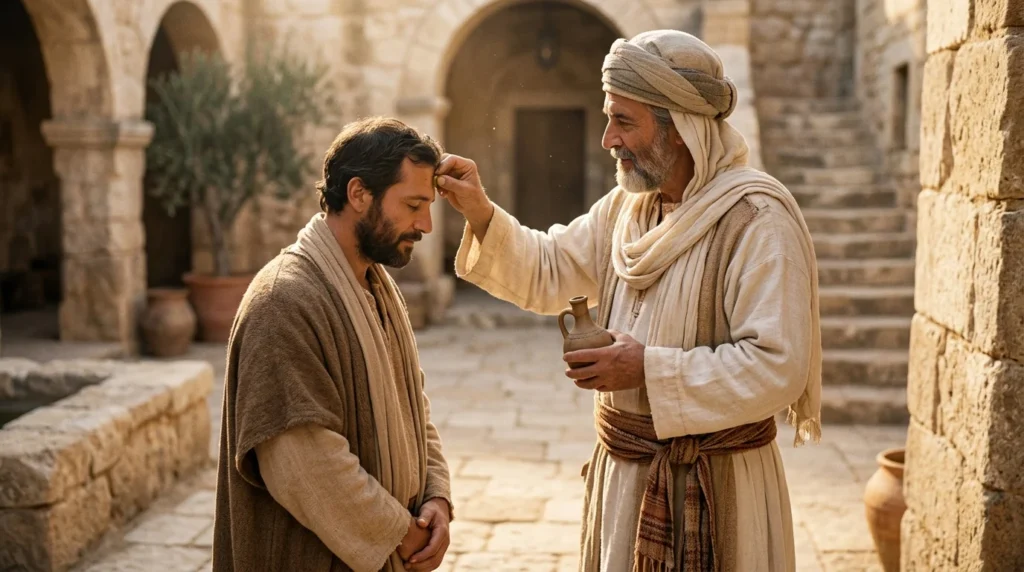
Perhaps the most well-known examples of anointing in the Old Testament involve Israel’s kings. When Samuel anointed Saul as the first king of Israel, he poured oil over Saul’s head and kissed him, declaring that the Lord had appointed him as ruler over His people.
Later, when Saul’s disobedience led to his rejection as king, God sent Samuel to anoint a young shepherd boy named David even though David was the youngest and least likely candidate among his brothers.
This moment illustrates a crucial truth about biblical anointing: God doesn’t choose based on human standards of status, age, or appearance. He looks at the heart.
Anointing Prophets
Prophets, too, were sometimes anointed, though this was less common than with kings and priests. Elijah was instructed by God to anoint Elisha as his successor, symbolizing the transfer of prophetic authority and the mantle of ministry from one generation to the next.
Anointing Objects and Places
Interestingly, anointing wasn’t limited to people. Jacob anointed a stone pillar at Bethel after his famous dream of the ladder reaching to heaven, dedicating that place as holy ground. The tabernacle, its furnishings, and later the temple were also anointed with oil, consecrating them for sacred use.
Anointed Bedeutung
The German meaning of anointed is gesalbt. In biblical contexts, it describes a person chosen or consecrated for a sacred purpose. The Bible also uses the concept of anointing to represent God’s presence, empowerment, and blessing.
The Anointed One: Jesus Christ as the Ultimate Fulfillment
No discussion of the anointed meaning in Bible theology would be complete without addressing its most significant fulfillment: Jesus Christ.
The very title “Christ” (Greek: Christos) means “Anointed One” the direct equivalent of the Hebrew “Messiah.” When the New Testament refers to Jesus as “the Christ,” it’s making a profound theological statement: Jesus is the one long-promised, anointed by God to be Prophet, Priest, and King all in one.
Jesus Fulfills All Three Anointed Offices
In the Old Testament, anointing was typically associated with three distinct roles:
- Prophet – One who speaks God’s word to the people.
- Priest – One who represents the people before God and offers sacrifice.
- King – One who rules and reigns with God-given authority.
Jesus uniquely fulfills all three:
- As Prophet, He taught with authority and revealed the Father’s heart.
- As Priest, He offered Himself as the once-for-all sacrifice for sin.
- As King, He reigns eternally, and Scripture declares that every knee will one day bow to Him.
In the Gospel of Luke, Jesus stood in the synagogue and read from the scroll of Isaiah, declaring that the Spirit of the Lord was upon Him because He had been anointed to preach good news to the people with low-income
The Anointing at His Baptism
When Jesus was baptized by John the Baptist, the Holy Spirit descended upon Him like a dove, and a voice from heaven declared Him as the beloved Son.
This distinction matters. It shows us that biblical anointing isn’t ultimately about the physical oil it’s about the Spirit of God resting upon a person to empower them for divine purpose.
Anointed Betekenis
The word anointed in Dutch means gezalfd (anointed). In the Bible, it refers to someone who has been set apart for a special purpose by God, often through the symbolic act of applying oil. Priests, kings, and prophets were anointed in biblical times to represent God’s calling, blessing, or authority.
Anointing in the New Testament: What Changed?

With the coming of Jesus and the outpouring of the Holy Spirit at Pentecost, the concept of anointing expanded dramatically. No longer was it reserved exclusively for kings, priests, and prophets.
Every Believer Is Anointed
One of the most beautiful truths in the New Testament is that all believers in Christ now share in His anointing.
This means that anointing, in a New Testament sense, isn’t reserved for spiritual elites, pastors, or “special” Christians. Every believer who has received the Holy Spirit carries a measure of that same anointing empowered to live out their calling, minister to others, and represent Christ in the world.
Anointing for Healing and Ministry
The book of James instructs believers who are sick to call the elders of the church to pray over them, anointing them with oil in the name of the Lord. This practice continues in many churches today, symbolizing faith, consecration, and a request for God’s healing power.
The Anointing That Teaches
The apostle John writes that believers have received an anointing from the Holy One, and that this anointing remains in them, teaching them all things meaning they don’t need anyone to instruct them beyond what the Spirit already reveals.
Symbolic Meanings Behind the Anointing Oil
Understanding why oil specifically was used helps deepen our appreciation of this practice. Olive oil held several layers of symbolic meaning in the ancient world:
- Healing and Soothing – Oil was used medicinally to soothe wounds, symbolizing God’s restorative power.
- Light – Oil fueled lamps, representing illumination, guidance, and revelation.
- Nourishment – Oil was a staple food source, symbolizing sustenance and provision.
- Set Apart Status – Because the holy anointing oil recipe was exclusive and could not be replicated for common use, it visually represented something sacred, distinct from the ordinary.
- The Holy Spirit – Throughout Scripture, oil consistently serves as a symbol for the Holy Spirit’s presence, power, and blessing.
When someone was anointed, onlookers understood immediately: this person or object now belonged to God in a special way.
Key Biblical Examples of Anointing at a Glance
To make this easier to visualize, here’s a quick breakdown of major anointing moments throughout Scripture:
- Aaron and his sons – Anointed as priests to serve in the tabernacle
- Saul – Anointed by Samuel as Israel’s first king
- David – Anointed as king while still a young shepherd
- Solomon – Anointed king, continuing David’s royal line
- Elisha – Anointed by Elijah as a prophet and his eventual successor
- Jesus – Anointed with the Holy Spirit at His baptism, fulfilling the role of Messiah
- Believers – Anointed with the Holy Spirit after placing faith in Christ
Each example reinforces the same central truth: anointing signifies God’s choice, God’s empowerment, and God’s purpose resting on a life.
What Does It Mean to Be “Anointed” Today?

So how does this ancient practice apply to modern believers? While we may not undergo a literal oil ceremony (outside of specific church practices like healing prayer), the spiritual reality of anointing remains deeply relevant.
Anointing Means Divine Calling
If you are anointed, it means God has a specific purpose for your life a calling that goes beyond your natural talents or human effort. Just as David was anointed years before he became king, your anointing may not immediately manifest in visible results. It often requires a season of preparation, character development, and faith.
Anointing Means Empowerment, Not Just Position
It’s important to note that anointing isn’t about status or title. Saul held the position of king, but Scripture tells us the Spirit of the Lord eventually departed from him due to his disobedience.
Position without genuine spiritual empowerment and obedience is hollow. True anointing flows from a relationship with God, not simply an official role.
Anointing Means Responsibility
With anointing comes accountability. Those who are set apart for God’s purposes are called to live in a manner worthy of that calling walking in integrity, humility, and faithfulness. The anointing isn’t given for personal gain or glory, but for service to God and others.
Signs You May Be Walking in Your Anointing
While every believer’s journey looks different, some common signs include:
- A growing sense of purpose or calling that won’t go away
- Supernatural grace or ability in a specific area of ministry or service
- Doors opening in ways you couldn’t orchestrate yourself
- A deepening hunger for God’s presence and Word
- Fruitfulness in helping, teaching, healing, or leading others
Common Misunderstandings About Being Anointed
Because “anointed” has become a popular phrase in modern Christian culture, it’s sometimes misused or misunderstood. Let’s clear up a few misconceptions.
Misconception 1: Anointing guarantees an easy life. David’s anointing didn’t spare him from years of hardship, betrayal, and running for his life. Anointing often leads through difficulty, not around it.
Misconception 2: Only pastors or leaders are anointed. As we’ve seen, Scripture teaches that all believers who have received the Holy Spirit carry an anointing, regardless of their role in the church.
Misconception 3: Anointing is about feeling something emotional. While anointing can be accompanied by a sense of God’s presence, it’s fundamentally about purpose and empowerment not a fleeting emotional experience.
Misconception 4: You can lose your salvation if you don’t “feel” anointed. Anointing and salvation, while related, are distinct concepts. Feeling spiritually dry doesn’t mean God’s calling on your life has been revoked.
Frequently Asked Questions About Anointed Meaning in Bible
1. What is the literal meaning of “anointed” in the Bible?
The literal meaning refers to the act of pouring or rubbing oil on a person or object as a sign of consecration, marking them as chosen and set apart for God’s purposes.
2. Why was oil used for anointing in the Bible?
Oil symbolized healing, provision, illumination, and most importantly, the presence and empowerment of the Holy Spirit. It was a physical representation of a spiritual reality.
3. Who were the main people anointed in the Bible?
Priests (like Aaron), kings (like Saul, David, and Solomon), and prophets (like Elisha) were anointed for their specific roles. Jesus Christ, the “Anointed One,” is the ultimate fulfillment of this practice.
4. What does it mean when someone says they are “anointed” today?
It typically means the person believes God has called and empowered them for a specific purpose or ministry, often accompanied by the presence of the Holy Spirit working through their life.
5. Is anointing only for pastors and church leaders?
No. According to the New Testament, every believer who receives the Holy Spirit is anointed in some sense, empowered to live out their unique calling and serve God’s purposes.
6. What is the connection between “Messiah,” “Christ,” and “anointed”?
Both “Messiah” (Hebrew) and “Christ” (Greek) literally translate to “Anointed One.” These titles identify Jesus as the one specifically chosen and empowered by God to fulfill the roles of Prophet, Priest, and King.
7. Can anointing be lost or taken away?
Scripture shows that anointing can be diminished through persistent disobedience, as seen with King Saul. However, for believers under the New Covenant, the sealing of the Holy Spirit is described as a lasting guarantee, though ongoing obedience and relationship with God remain important for walking fully in one’s calling.
Final Thoughts: Embracing the Anointed Meaning in Bible Truth
Understanding the anointed meaning in Bible context reveals something profound: anointing is far more than an ancient ritual involving oil. It’s a picture of God’s intentional choosing, His empowering presence, and His purpose being placed on ordinary people to accomplish extraordinary things.
From Aaron the priest to David the shepherd-king, from Elisha the prophet to Jesus the promised Messiah, the thread of anointing runs consistently through Scripture always pointing toward God’s desire to dwell with His people and work through them.
Read More Articles

William Turner is a passionate writer who enjoys exploring meaningful ideas, biblical insights, and the stories behind words and traditions. His goal is to make every article simple, helpful, and engaging for readers around the world.