Have you ever wondered what Ephah means in the Bible and why this word appears in different biblical passages? Ephah can refer to both a biblical place or clan name and a unit of measurement used in the ancient Israelite world, depending on the context.
As a measurement, an ephah was a large dry measure commonly used for grain and other agricultural products. The Bible also mentions Ephah as the name of descendants and groups connected with Abraham’s family.
Understanding the Ephah meaning in the Bible therefore requires looking at the specific passage where the word appears. In simple terms, Ephah can refer to an ancient unit of dry measurement or a biblical name associated with people and places, making context important when interpreting it.
The Literal Meaning of Ephah: A Unit of Measurement

How Much Was an Ephah, Exactly?
Biblical scholars generally agree that one ephah was equal to approximately:
- 22 liters (or about 5.8 U.S. gallons)
- Roughly 3/5 of a bushel
- Around 10 omers (since an omer was a smaller unit of measure, as referenced in Exodus 16:36)
Where Does the Word Come From?
Interestingly, many scholars believe the term “ephah” may have Egyptian origins, since Israel spent centuries in Egypt before the Exodus. Egyptian units of measurement often made their way into Hebrew vocabulary, and the ephah appears to be one of these borrowed terms. This makes sense historically a people who had just come out of Egyptian slavery would naturally carry over familiar terms for everyday trade and commerce.
The Ephah’s Relationship to Other Biblical Measurements
To fully grasp the ephah meaning in the Bible, it helps to see how it fit into the broader system of ancient measurements:
- 1 homer = 10 ephahs
- 1 ephah = 10 omers
- 1 ephah (dry) roughly corresponded to 1 bath (liquid measurement) in volume, though one measured dry goods and the other measured liquids like wine or oil
This system mattered because it created standardization a crucial concept we’ll explore more below.
Why the Ephah Mattered So Much in Ancient Israel
Fair Trade and Honest Business
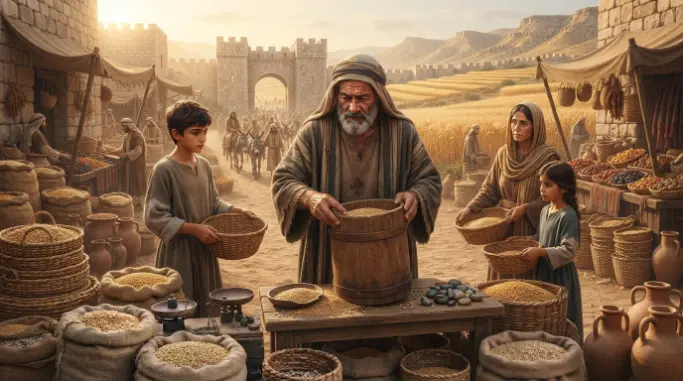
One of the most important themes connected to the ephah in Scripture is honesty in commerce. God cared deeply about how His people conducted business with one another, and the ephah became a symbol of fairness or, when abused, a symbol of corruption.
Several verses explicitly command the Israelites to use accurate ephah measurements:
- Leviticus 19:36 instructs the people to use “just balances, just weights, a just ephah, and a just hin.”
- Deuteronomy 25:14-15 warns against having two different ephah measures in your house one larger and one smaller used to cheat customers.
- Micah 6:10-11 condemns the wicked practice of using a “scant” or shortened ephah to defraud buyers.
This is such a powerful and relevant lesson even today. God wasn’t just concerned with religious rituals; He cared about everyday integrity how people treated each other in the marketplace. A dishonest ephah wasn’t just a business crime; it was viewed as a moral and spiritual failure.
Use in Grain Offerings and Worship
The ephah also played a role in temple worship and sacrificial offerings. In several passages, grain offerings are measured out in ephahs or fractions of an ephah:
- Ezekiel 45:11 establishes the ephah and the bath as the standard units for measuring offerings, ensuring both dry and liquid offerings followed the same consistent scale.
- Ezekiel 45:24 and Ezekiel 46:5-11 describe specific grain offerings measured in ephahs, tied to different types of sacrifices (bulls, rams, lambs).
- Numbers 5:15 references a tenth of an ephah of barley flour used in a jealousy offering.
The Symbolic Meaning of Ephah in Prophetic Scripture
Now let’s turn to one of the most fascinating and often overlooked uses of the ephah its symbolic role in prophecy.
Zechariah’s Vision of the Woman in the Ephah
In Zechariah 5:5-11, the prophet Zechariah receives a strange and vivid vision. He sees a large ephah basket, and inside it sits a woman who is identified as “Wickedness.” Two winged women then lift the ephah basket, with the woman inside, and carry it away to the land of Shinar (ancient Babylon), where a “house” is being built for it.
This vision is rich with symbolic meaning:
- The ephah, normally a symbol of fair trade and provision, becomes a container for sin and wickedness.
- The image suggests that wickedness can be measured, contained, and ultimately removed from the land God was symbolically showing that sin would be dealt with and relocated away from His people.
- The choice of an ephah (rather than some other container) is significant because it ties corruption directly back to the earlier warnings about dishonest business practices and greed.
Why This Symbolism Matters Today
This passage teaches us something profound: the tools and systems we use in everyday life whether it’s money, business, or measurements can either reflect God’s justice or become vehicles for corruption. The ephah’s dual symbolism (honest provision vs. hidden wickedness) reminds us that integrity in the “small things” of daily life carries spiritual weight.
Ephah as a Personal Name in the Bible
Here’s a fun fact that many readers miss: “Ephah” wasn’t just a unit of measurement it was also used as a personal name in Scripture.
- Genesis 25:4 and 1 Chronicles 1:33 mention Ephah as one of the sons of Midian, who was a son of Abraham through his wife Keturah. This makes Ephah a grandson of Abraham through a lesser-known branch of the family line.
- 1 Chronicles 2:46 mentions a woman named Ephah, described as a concubine of Caleb, from the group of Judah.
- Isaiah 60:6 references “Ephah” as a place or people group associated with camels and gold, likely connected to the Midianite descendant mentioned in Genesis. This verse pictures nations bringing gifts to Israel, with Ephah representing distant lands bringing tribute and honor.
Key Bible Verses That Mention the Ephah
To help you study this topic further, here’s a handy list of the major verses where the ephah appears:
- Exodus 16:36 – Defines the omer in relation to the ephah
- Leviticus 5:11 – A tenth of an ephah of fine flour used as a sin offering for the poor
- Leviticus 6:20 – A grain offering measured by the ephah
- Leviticus 19:36 – Command to use a “just ephah”
- Numbers 5:15 – A tenth of an ephah of barley flour for a jealousy offering
- Numbers 28:5 – A tenth of an ephah of flour for a daily offering
- Deuteronomy 25:14-15 – Warning against dishonest weights and measures
- Ruth 2:17 – Ruth gathers about an ephah of barley
- 1 Samuel 1:24 – Hannah brings an ephah of flour when dedicating Samuel
- 1 Samuel 17:17 – Jesse sends an ephah of grain to his sons on the battlefield • Isaiah 5:10 – A prophecy about agricultural scarcity, measured in ephahs
- Ezekiel 45:10-11, 24 – Establishes standard measures including the ephah
- Ezekiel 46:5-11 – Grain offerings measured in ephahs
- Amos 8:5 – Rebuke of merchants shrinking the ephah to cheat customers
- Micah 6:10 – Condemnation of the “scant” or wicked ephah
- Zechariah 5:6-11 – The symbolic vision of wickedness in an ephah basket
Practical Lessons We Can Learn From the Ephah
Even though most of us will never use an ephah basket in our daily lives, the spiritual and moral lessons behind it are timeless. Here are a few key takeaways:
- Integrity matters in the details. God cared about something as small as a grain measurement, which tells us He cares about honesty in every area of our lives not just the “big” moral issues.
- Generosity leaves a mark. Boaz’s generosity toward Ruth, measured in an ephah of barley, reminds us that small acts of provision can have a lasting impact on someone’s life.
- Corruption often hides in ordinary systems. Zechariah’s vision shows that wickedness doesn’t always look dramatic sometimes it hides inside the everyday tools and systems we use, like commerce and trade.
- God notices and eventually deals with injustice. The prophets repeatedly warned against dishonest ephahs, and Zechariah’s vision shows that God ultimately removes wickedness from among His people.
Frequently Asked Questions About Ephah Meaning in the Bible
1. What does ephah mean in the Bible?
The ephah meaning in the Bible refers to a unit of dry measurement, roughly equal to 22 liters, used mainly for measuring grain, flour, and other agricultural goods in ancient Israel. It also appears symbolically in prophetic literature, particularly in the Book of Zechariah.
2. How big was an ephah compared to modern measurements?
An ephah was approximately 22 liters, or about 5.8 U.S. gallons. It’s roughly equivalent to three-fifths of a bushel, making it a moderate, everyday quantity used for household grain measurement.
3. Why does the Bible mention dishonest ephahs?
Several Old Testament prophets, including Amos and Micah, condemned merchants who used two different ephah measures a smaller one for selling and a larger one for buying to cheat customers. This practice was considered a serious moral and spiritual offense, since God commanded honest weights and measures.
4. What is the significance of the woman in the ephah in Zechariah’s vision?
In Zechariah 5:5-11, a woman representing “Wickedness” is placed inside an ephah basket and carried away to Babylon. This symbolic vision represents God removing sin and corruption from the land of Israel, using the very container once associated with honest trade to carry wickedness away.
5. Is Ephah also a person’s name in the Bible?
Yes. Ephah appears as a personal name in Genesis 25:4, referring to a son of Midian and grandson of Abraham. It’s also used as a woman’s name in 1 Chronicles 2:46 and as a place or people group in Isaiah 60:6.
6. How many omers made up one ephah?
One ephah was equal to ten omers, according to Exodus 16:36, which explains the relationship between these two units of dry measurement used in ancient Israel.
7. Why did Ruth gather an ephah of barley?
In Ruth 2:17, Ruth gleaned about an ephah of barley in Boaz’s field in a single day. This generous amount suggests that Boaz intentionally instructed his workers to leave extra grain for her, symbolizing God’s provision and Boaz’s kindness toward Ruth and Naomi.
Final Thoughts:
Understanding the ephah meaning in the Bible gives us so much more than a history lesson in ancient measurements. It reveals how God’s concern for justice, honesty, and provision touched even the smallest details of daily life in ancient Israel. From honest business dealings to Ruth’s gleaning field, from grain offerings in the temple to Zechariah’s haunting vision of wickedness carried away in a basket, the ephah threads its way through Scripture as a quiet but powerful symbol.

James Wilson is a passionate writer who loves exploring meaningful ideas, biblical insights, and topics that inspire everyday life. Through TruthVarse.com, he shares simple, thoughtful, and easy-to-understand content to help readers discover truth, meaning, and inspiration.